
After reading TheBooks That Mattered by Frye Gaillard, I also had the pleasure of hearing
him speak about the books that shaped him as a writer and human being at the 2013 Spalding University M.F.A. in Writing Residency.

Both his reader’s memoir and his
speech resonated with me, and I started thinking about which books have mattered
the most to me. Shortly thereafter, I started getting tagged by all my writer
friends with the Facebook 10 Books That Stuck With You task. Some people
annotated their lists, but in the crush of end of the semester grading, I
tossed out some titles and authors and moved on. But the question has stayed
with me. What books have stuck with me? The answer is certainly longer than
ten, so I’ve split my list into sections. The first installment is Books That
Transcended Childhood.
1. P.D. Eastman’s AreYou My Mother? is a harrowing narrative about a lost baby bird looking for
her mother. She asks the cat, the dog, the cow, even a construction tractor, if
they are her mother. All of them say no. Just when I think there’s no hope,
that the baby will be lost forever, she does find her mother bird. There is
such tremendous relief in the moment of connection between baby and mother that
I read that book over and over as a child.
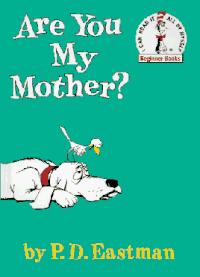
No matter how many times I read Are You My Mother? I never felt less anxious about the baby bird’s
fate. Perhaps I even connected with the book because of the anxiety. My mother
made it plain that if I ever got lost, it would be my fault. My job was to
stick to her, and if I ever wandered off, she’d say, “Hope you find a good
home!” So, there was some anxiety about being separated from my mother, my
home. But I also knew that I was loved, and so however anxious a situation
might get, I knew, and the book reassured me, that there would be a happy
ending.
As an adult, I see a bigger thread emerge. As an artist, a
writer, a woman who has never quite fit in, my life has been a long search for
others like me. Oh, the anxiety of new situations, new schools, new jobs, and
new social situations where I’m not quite sure who my people are. Oh, the
relief when I do find my people. I don’t think my experience is unique. Humans
search for connection. Are You My Mother?
is about the torture of the search and the promise that if we don’t give
up, connection and acceptance will be our reward.
2. The Story of Ferdinand by
Munro Leaf is such an all time favorite of mine that I wrote an essay about it
in graduate school that won me free books for a semester. Ferdinand is a young
bull who loves to sit in the field and smell flowers. When the men from the
city come to look for bulls to fight in the ring, they are so impressed with
his bee sting induced bucking and running that they take him to compete in the
bullfights. When the big moment comes, Ferdinand is released into the ring.
Instead of fighting, he sits down and smells the flowers in the ladies’ hair. He’s
shipped back home where he returns to his favorite tree.

Ferdinand is my hero. He is different from everyone else,
but it doesn’t bother him. He knows what he loves to do, and he doesn’t let
anyone pressure him into being different. He is a pacifist, but he doesn’t judge
others for their decisions. He quietly makes decisions for himself and sticks
to it.
I remember when my mom told me what happens in a bullfight,
I was shocked and outraged. They’re planning to do what to Ferdinand? In this story, I see the beginnings of my pacifism,
animal rights advocacy, and vegetarianism. I also think that repeated readings
of Ferdinand made me feel okay about
being different and honed in me the belief that everyone deserves the chance to
be who they are free of pressure to be something else. All my life, I have struggled with being a
people pleaser. The Story of Ferdinand reminds
me that it’s more important to please myself.
3. My third book on the list is one I hated: Green Eggs and Ham by Dr. Seuss. My
mother swore that I loved this book, but I remember trying to sell it at a yard
sale and her anger when she discovered that I wanted to get rid of my favorite
book. I don’t remember asking to hear the book a million times, but she said I begged
for it. What I remember is the horrible pressure the character felt to eat
something he didn’t want to eat. He is bribed and tricked and finally does eat
the green eggs and ham. And he likes them! What a betrayal.

One Sunday, we were at a church fundraising breakfast, and
the eggs really were green. My mom wouldn’t let me eat them. “But, green eggs!”
I said, “Just like the book.”
“No one really eats green eggs,” Mom said. They made an
announcement that the green came from the grease and that the eggs were safe to
eat. My mom still wouldn’t let me eat them.
That day at the fundraiser may have been the beginning of my
dislike of eggs, but it sure wasn’t the beginning of my being a picky eater.
Whip cream, melons, puddings, bananas, coffee, iced tea, and so very many
more--there were a lot of foods I refused to eat.
“You’ll grow into them,” my dad said.
“No, I won’t,” I always thought in reply.
Fast forward thirty (cough, cough) years, and we were both
right. I did grow into a taste for wine and weird cheeses, but most of the
things I wouldn’t eat as a child, I still despise. After struggling with
allergies for years, I finally underwent the painful process of allergy
testing. Guess what? Most of the things people tried to force on me for years
belong to families of things I’m allergic to.
So, take that Green
Eggs and Ham. Sometimes a kid doesn’t want to eat something because it’s
gross. Sometimes, the adults should listen to the kid and leave her alone with
her peanut butter and jelly sandwiches. Except I turned out to be allergic to
peanuts, too, but that’s another story.
